




How to Evaluate a Purportedly Accurate Visitor Counting System
Every people counting vendor publishes an accuracy figure. Most don’t explain what it means. This guide breaks down how accuracy is measured, what conditions affect it, and what to ask before you take any number at face value.
Why “98% accurate” is harder to compare than it looks
A single percentage is meaningless without knowing the conditions under which it was measured. The same sensor can test at 99% accuracy over light, single-file foot traffic and drop sharply when two people walk in shoulder-to-shoulder, when a stroller passes through, when occlusion occurs, or when a queue forms near the entrance at peak hours. An accuracy claim is only as credible as the test protocol behind it. And most claims don’t disclose one.
This guide explains how the number is derived, what factors move it up or down, and how to validate any claim before you build a budget or a business case on top of it.
The variables that move accuracy up or down
Accuracy is not a fixed property of a sensor. It’s the result of how a given technology performs under your specific conditions.
Sensor technology
Break-beam and basic infrared counters are inexpensive but struggle to distinguish direction and count groups. Single-lens 2D video is sensitive to lighting, shadows, and partial obstructions. Stereo-vision sensors use dual lenses to perceive depth, allowing them to distinguish people walking side by side and maintain accuracy in high-traffic conditions. The people counting technology sets the ceiling on what’s achievable.
Occlusion
When one person is hidden from the sensor’s view by another, or by a physical obstruction or crowd overlap, the result is typically an undercount or misidentification. Occlusion can affect any sensor technology. Even 3D stereo-vision sensors, which use depth and height calculations to distinguish individuals, can experience miscounts when two people of similar height walk in perfect single file, one directly behind the other.
Traffic density
Accuracy that holds at 100 people per hour can degrade meaningfully at 1,000. Ask for the figure at your realistic peak, not your average.
Children, staff versus customers, re-entries, and people who pause in the doorway without committing to enter; decide which of these you need the system to handle before you compare claims.
Group behavior
Side-by-side entry, tailgating, hand-holding, shopping carts, and strollers are where weaker systems lose accuracy. This is the single most common gap between a lab number and a real-world number.
Mounting height and coverage width
Wider coverage from a higher mount can come at the expense of precision. The relevant number is the one for your entrance width and ceiling height, not a spec-sheet ideal.
Environment
For video-based sensors, direct sunlight at a glass entrance, reflective floors, and low light may affect performance. Outdoor and semi-outdoor installations add another layer of complexity.
Net count vs. directional accuracy: two very different numbers
Before comparing vendors, it helps to understand that “accuracy” can mean two things:
Net count accuracy measures whether the total in-minus-out number is roughly correct at the end of a period. It can look excellent even when the underlying counts are wrong, because over-counts and under-counts cancel each other out over the course of a day.
Directional (in/out) accuracy measures whether each individual entry and exit is captured correctly. This is the number that matters if you care about real-time occupancy, conversion rates, or dwell time, and it is almost always lower than a vendor’s leading net figure.
If a vendor quotes an accuracy figure without specifying which measurement they’re using, that’s your first question.
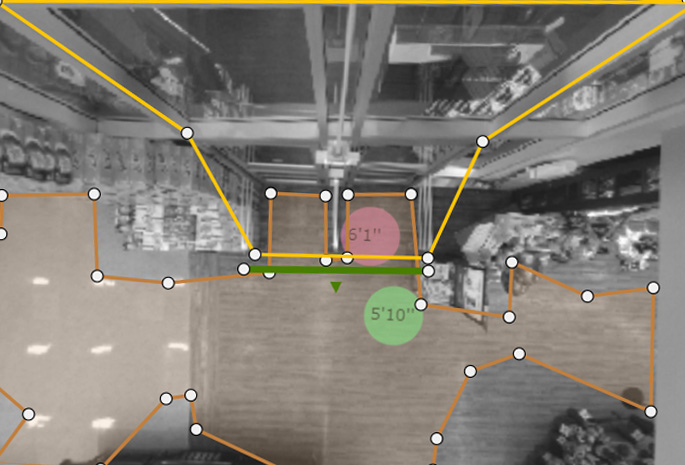
How SenSource derives and maintains its accuracy figures
At SenSource, we guarantee 98% accuracy, and many of our customers routinely see 99% or higher in real-world environments. Here’s exactly how we arrive at, and sustain, that number.
Hardware validation before we ever recommend a sensor. When evaluating a new sensor model, we conduct structured internal tests that simulate the scenarios our customers actually face: varying walking patterns, multiple directions, group sizes from single travelers to families with strollers, and edge cases like carts and bags. Every test compares the sensor’s captured counts directly against manual ground-truth counts. A model only enters our recommended lineup if it meets our accuracy standards. And the testing also tells us under which specific conditions each sensor performs best, so we can match the right hardware to each customer’s entrance geometry, ceiling height, and expected traffic patterns.
Ongoing proactive monitoring included with every subscription. Accuracy isn’t something we set and forget. Every SaaS subscription includes continuous monitoring of traffic flow across every deployed sensor, using a proprietary calculation we’ve built to detect accuracy drift before it affects your data. If a device falls out of spec for longer than a defined threshold, an alert is automatically generated for our Support team. In most cases, we identify and resolve the issue without any action required on your end. When the root cause involves a change on-site, such as a floor layout shift, a new display near the entrance, or a network issue, our team contacts you directly and works through the fix together until accuracy is restored to 98% or better.
This combination of pre-deployment hardware validation and post-deployment monitoring is what separates a guaranteed accuracy figure from a marketing claim.
How to validate any vendor’s claim
A credible vendor will support, not resist, independent verification. Two practical approaches:
Ground-truth comparison
Manually count a representative period, including at least one busy stretch, and compare it against the system’s output. A reputable vendor should be able to show you a validation study done this way, or help you run one at your location.
Pilot before full rollout
Install in one real location under real conditions and measure before committing across a portfolio. Reluctance to pilot is itself a data point.
The honest signal: methodology, not just a number
The tell isn’t who claims to have the most accurate visitor counting system. It’s who can explain how they got it, including the test conditions, whether it’s net or directional accuracy, the traffic volume it was measured at, and whether there’s customer-run or third-party validation to back it up. A vendor who publishes an accuracy number alongside their methodology invites scrutiny. A vendor who publishes only a number is asking for trust without it.